Former B&W Employee Seeks $1.5M for Alleged Wrongful Termination

Brian Bradley
WC Monitor
11/6/2015

A former Babcock & Wilcox employee is suing the company, along with recent spinoffs BWXT and BWXT Nuclear Operations Group, for at least $1.5 million as a result of lost compensation and benefits and other damages she said resulted from her wrongful termination in 2013, according to a complaint filed Oct. 30 at United States District Court for the Western District of Virginia in Lynchburg, Va. The plaintiff, Faye Brooks, said in the six-page complaint that B&W fired her on Oct. 29, 2013, for violating a work safety rule that she was “specifically trained to avoid where necessary” and that was “routinely ignored” by her counterparts. “In this sense, then, Brooks was routinely asked to ignore safety and, in turn, the law,” the complaint states. Court documents make no mention of the specific safety rule in question. BWXT spokesman Jud Simmons declined to comment on the lawsuit, citing company policy, and Brooks’ attorney, Richard Hawkins, did not respond to requests for comment.

The complaint alleges that Brooks’ termination, said to be in in connection with an event that occurred on Oct. 21, 2013, was planned by B&W for “quite some time,” and that immediately afterward a former colleague was “walking around the facility telling fellow employees that ‘they had been trying to get [Brooks] fired for a long time.’” Brooks insists that B&W fired her after 23 years with the company because it wanted to replace her with a younger, “cheaper” employee, specifically one who got less in welfare and pension benefits. The complaint does not identify Brooks’ former position with the company.

 “Soon after Brooks was wrongfully terminated, B&W replaced her with someone with significantly less experience and significantly less entitlement to welfare and pension benefits provided by B&W,” the complaint states. “Separately, B&W wrongfully fired Brooks because, on the one hand, it told her to engage in unlawful conduct and, then, hypocritically, fired her for the very conduct it required her to perform.” Brooks has been unable to find a comparable full-time job, the complaint adds.

Brooks is seeking more than $1 million for loss of salary and benefits she would have been entitled to if not terminated. She is also seeking over $150,000 in compensatory damages for “humiliation, damage to … reputation, mental and emotional distress, occupational losses, and pain and suffering” she claimed to have experienced after the termination. Brooks is additionally seeking in excess of $350,000 in punitive damages against B&W. Exact amounts sought will be determined at trial, according to the complaint.

In This Issue

More on This Topic


Santa Susana watchdog criticizes DOE cleanup approach, seeks timeline

A watchdog group is pressing the Department of Energy for clarity on its remediation plans at the Santa Susana Field Laboratory in California, saying a proposed change in approach could delay work and leave contamination in place.

Melissa Bumstead, founder of Parents Against SSFL, told Exchange Monitor that DOE is moving away from the background cleanup required by its agreement with California toward a “multiple lines of evidence” approach. The latter is one of three new soil cleanup alternatives under consideration. Bumstead believes the change could amount to a “risk-based cleanup” that allows more contamination to remain. The group has not received a firm timeline for the outstanding documents and decisions, she said.

The Boeing Company, NASA and the Department of Energy are the three parties responsible for cleaning up the 2,850-acre site located 30 miles from downtown Los Angeles. DOE and its predecessor agencies did decades of nuclear metals research at the Energy Technology Engineering Center (ETEC). The last of the ETEC buildings was torn down in 2021. 

The sprawling SSFL site, between Chatsworth and Simi Valley, was developed for rocket engine testing and nuclear research. Its ETEC site included 10 small reactors used for research from the 1950s into the 1980s.

Cleanup advocates contend that California’s final environmental review, released in June 2023, allows much of the contaminated acreage to remain above background levels, rather than requiring removal of all contamination attributable to site operations. Bumstead said DOE’s soil cleanup in Area IV has not begun and described the work as roughly a decade behind schedule. 

In a March 6, 2025 public scoping meeting Josh Mengers, federal site director for ETEC, called the original lookup-table values “not implementable.”

“It’s a list of reasons why they can’t and they won’t, and nobody is standing up to them,” Bumstead said.

DOE’s 2018 final environmental impact statement estimated $774 million for a soil cleanup alternative intended to meet contamination limits in its 2010 administrative order with California regulators. The estimate covers Area IV and the affected Northern Buffer Zone, not the entire site or all DOE cleanup work.

 In 2018, a California Department of Toxic Substances Control (DTSC) timeline projected cleanup work would begin in 2019 and could finish in 2034. DTCS is coordinating with DOE on a draft soil cleanup plan, which DTSC expects DOE to release for public review and comment in 2029. 

DOE’s prime cleanup contractor, North Wind Portage, was awarded a $1.9 million extension in 2023, bringing the value of its environmental work task order at DOE’s portion of SSFL to $66.4 million. CDM Smith, a subcontractor, conducts groundwater testing and supports cleanup planning. Both companies declined to comment.

DOE’s Office of Environmental Management said it is working with DTSC on final cleanup plans for soil and groundwater, each with its own timeline and opportunities for public input. The agency said it and its contractors have remediated or demolished more than 270 structures, including the final 18 DOE-owned buildings in Area IV. Above-ground demolition and waste removal were completed in 2022, and interim groundwater measures have removed more than 97,000 gallons of contaminated groundwater since 2017.

“DOE remains committed to a scientifically sound, implementable cleanup at ETEC,” Mengers said.

EM-ETEC’s October newsletter described ongoing groundwater treatment pilot projects, sampling and monitoring efforts but announced no final soil cleanup decision. The next community meeting is scheduled for Nov. 12.

In This Issue

More on This Topic


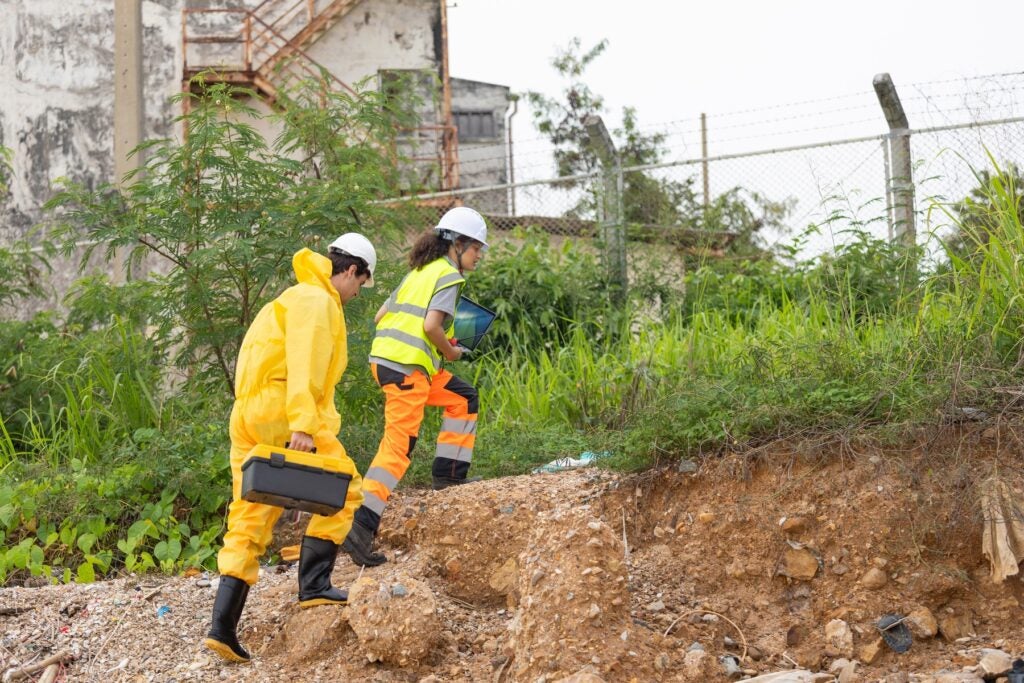
Environmental scientists in protective suits surveying contaminated soil at an industrial cleanup site.

Coming Up:

Here are events related to nuclear matters that Exchange Monitor staff are tracking:  OCTOBER: 27: Conference: The Energy Technology & Environmental Business Association (ETEBA) holds its annual business opportunities and technology conference at the Knoxville, Tenn., Convention Center.  28: Earnings call: Parsons will hold its quarterly earnings call with financial analysts starting at 8 a.m. […]